You found this place for a reason.
Maybe someone mentioned it. Maybe you searched for ACT resources and landed here. Maybe you have been practicing for years and something about the language on this site felt different from the usual. Whatever brought you here, this page exists to help you get oriented quickly and find what actually fits where you are right now.
The Relational Institute of Applied Contextual Therapies (RIACT) is a professional learning community for clinicians built on Functional Contextualism (FC), Relational Frame Theory (RFT), and Process Based Therapy (PBT) often demonstrated as Acceptance and Commitment Therapy (ACT).
The goal is straightforward: help therapists move beyond rigid models and develop clinical work that is psychologically flexible, functionally grounded, and sustainable over time.
That applies whether you are seeing your first ACT-informed client or have been practicing contextually for a decade.
What this place actually is
RIACT is more than just a content library with a paywall in front of it. It is a working professional community organized around a shared theoretical framework. The tools, the training, the supervision model, and the community all point in the same direction.
The science that informs how we help clients change is also the science we use to think about how clinicians grow, how supervision works, and how professional development actually sticks. That is not a marketing position. It is the operating logic of how this community is structured.
Most of the work here applies through ACT. Any clinician who thinks contextually and functionally about behavior, language, and human change will find meaningful ground here.
Where you fit — choose your path
The site has a lot in it. The fastest way to orient is to find yourself in one of these descriptions and follow that thread.
You are new to ACT and want to understand it from the ground up
Start with the ACT Basics Pathway. It covers what ACT is and what it is not, the six core flexibility processes, a clinician-friendly introduction to Functional Contextualism, and the basic role of language and RFT in understanding how suffering works. The focus is on orientation and coherence, not mastery. You do not need prior training to follow it.
The Deeply Functional podcast is a strong companion if you learn well through conversation. Both the pathway and the podcast are accessible at the Foundation tier — free, no credit card, no expiration.
A good first read: What is Acceptance and Commitment Therapy — it gives you the core idea without jargon and explains why ACT does not target thoughts and feelings the way most approaches do.
You already use ACT and want deeper tools and real practice
You are probably here because something felt incomplete. Maybe you know the hexaflex well but find yourself defaulting to technique rather than tracking what is actually happening functionally. Maybe your documentation does not reflect how you are actually thinking. Maybe you want supervision that develops your craft rather than monitors your compliance.
FlexLab is where written knowledge becomes practiced behavior. It meets monthly in multiple formats — in-person in Cranston, RI and virtually — and is designed as a collaborative practice space. Bring a case. Observe. Step in when ready. No previous ACT experience is required, and no one is here to evaluate your performance.
The FPN Practice Tool is an AI tool trained specifically on RIACT's clinical frameworks. It helps clinicians think functionally about documentation, case conceptualization, and clinical decision-making. It was built for this work, not as a general-purpose assistant.
A good starting point in the library: Functional Case Conceptualization and Reading Psychological Inflexibility in Session. These two pieces describe the clinical stance in practical terms.
You are an experienced clinician, supervisor, or trainer looking for serious tools and community
You likely already know the theory. What you may be looking for is a professional context that matches where your thinking has taken you — and infrastructure that reduces the friction of practice without asking you to compromise your approach.
The Clinical and Immersive membership tiers were built for this. Clinical membership gives you the full AI tool suite — the FPN Assistant, Session Bridge, and the ACT Treatment Planner — along with business support documentation and direct consultation access. Immersive adds the full community layer: Slack channels organized around clinical and practice topics, group trainings, and functional case discussions with other clinicians working from the same theoretical base.
The Intensive tier is for clinicians who want to move fast. Two sixty-minute consultations per month with a peer-reviewed ACT trainer, priority access across the ecosystem, and a cohort limited to twelve members. There are currently five spots remaining.
You want practical clinical tools right now
Go directly to the Tools section. You will find the AI clinical tools, clinical worksheets and experiential exercises, the FPN documentation framework, and practice resources organized by function. If you are at the Explorer tier or above, the FPN Practice Tool is available immediately. Foundation members have access to foundational worksheets and resources without a paid subscription.
You are looking for community, training, or consultation
RIACT operates as a relational community, not just a resource hub. Members connect through Slack, FlexLab, small consultation groups, and periodic broader conversations about the field and the future of contextual behavioral science. The Directory lists members and their areas of practice. The Training Schedule shows what is coming up. The Residency program is a structured path for clinicians who want sustained, immersive development over time.
What makes this different
Many sites use ACT language. The difference here is that Functional Contextualism and RFT are not the branding — they are the actual operating logic of how the community is built and how it functions.
That means the focus here is on:
Function over symptom labels. The question is not what diagnosis fits, but what contextual variables are maintaining the pattern.
Flexibility over rigid protocols. Protocols are useful starting points. Clinical fluency means knowing how to track and respond to what is actually happening in the room.
Process over manualized technique. ACT is not a set of exercises to deliver in sequence. It is a way of understanding how language and context shape behavior — and how to use that understanding in real sessions with real people.
Sustainable practice over burnout. A clinician who is well-supported, grounded in real science, and genuinely connected to their values does better work and stays in this field with their integrity intact. That is not incidental to the mission. It is the mission.
The aim here is not to produce clinicians who can recite ACT concepts on demand. The aim is to develop functional fluency — the kind of clinical understanding that shows up in how a practitioner listens, responds, and tracks what matters in a session.
Membership — what it costs and what you get
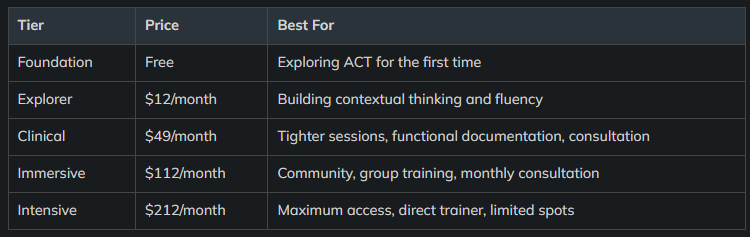
Foundation is a genuine starting point, not a teaser. It includes introductory articles, access to three live FlexLab sessions, foundational clinical worksheets, and the weekly community update.
Explorer adds full access to ACT essays, applied reflections, the Deeply Functional podcast with extended companion content, and a seven-day free trial before any commitment.
Full details on what each tier includes are on the Membership page.
Stay connected
RIACT publishes regularly — articles, case reflections, clinical tools, FlexLab session summaries, and podcast episodes. The weekly update is the simplest way to stay current without having to check in manually. You can join the mailing list from anywhere on the site.
The Slack community is available to Immersive members and above. The Facebook group is open and a lower-barrier way to connect with others who are working from a contextual perspective.
Upcoming training events are listed on the Training Schedule.
Not sure where to start?
If you read through all of this and still are not certain where to begin, start with one of these two pieces. They give you the clearest picture of the stance behind everything here:
→ The Basic Stance — what it means to think functionally and contextually about behavior
→ What ACT Looks Like in Real Practice — a grounded description of how this framework shows up in an actual session
You are in the right place. Take your time. The community is not going anywhere, and neither is the work.